

The Calendar as Editorial Identity: How to Rethink Community Time
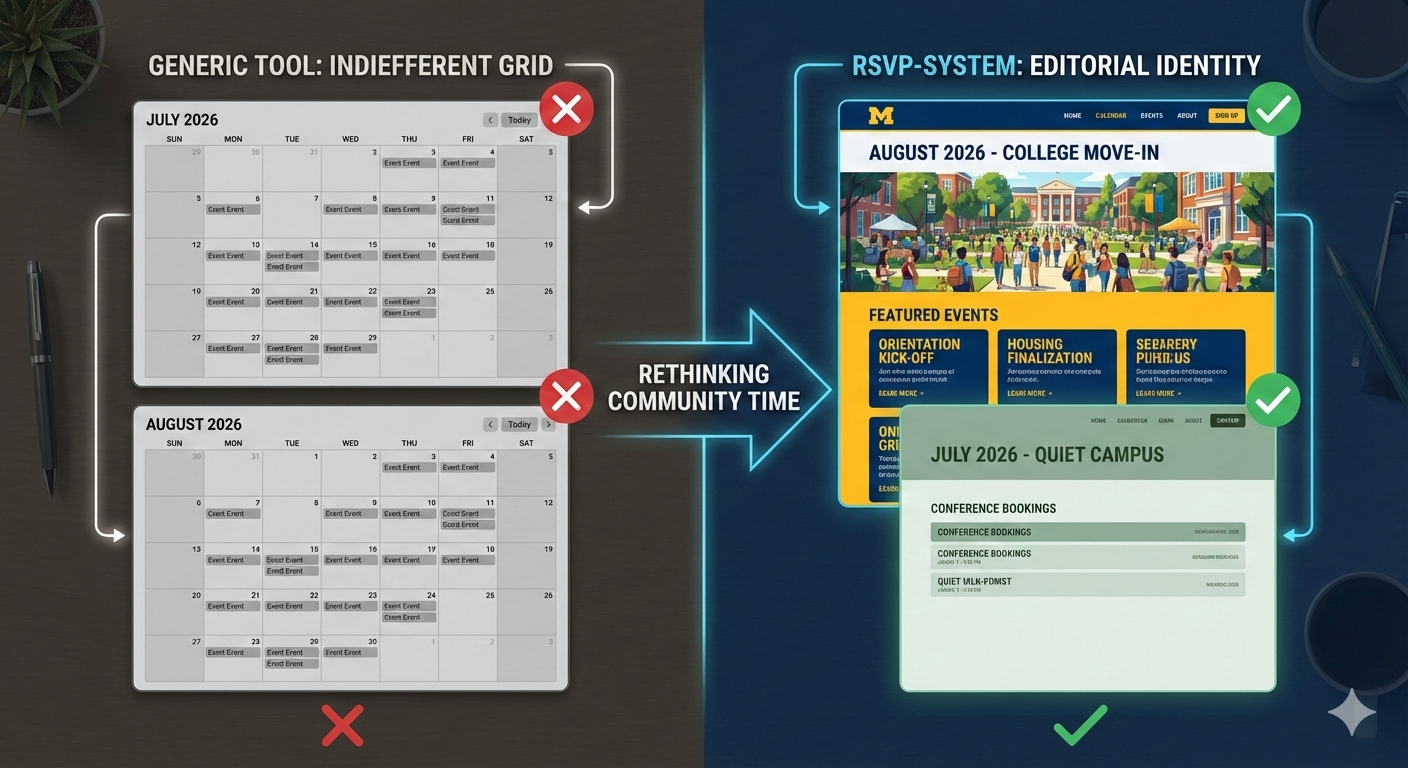
Every scheduling tool I've ever used treats a calendar the same way: as a container for events, filtered by date. You pick a month, you see what's in it. January looks like July. August looks like November. The tool is indifferent to meaning.
But communities don't experience time that way.
At a college, August isn't just another month. It's move-in week, orientation, the opening of the academic year — the single highest-stakes coordination moment in the institution's calendar. The physical plant is mobilized, housing assignments are finalized, hundreds of families are navigating campus for the first time. That month needs a different editorial posture than July, when the campus is quiet and the biggest reservation concern is whether the conference center is booked.
This asymmetry is obvious to anyone who's worked in higher education, or municipal government, or a community center. Yet almost no scheduling software accommodates it. They give you a grid. They let you put things in the grid. They do not help you say: this month matters more, and it should look like it.
RSVP-System is going to change that.
A Month Is Not Just a Date Range
The architectural insight that cracked this open for me came from thinking about magazines.
Every issue of a magazine is the same type of object — same masthead, same sections, same general structure. But each issue has its own editorial identity. The September issue is a phenomenon. The February issue has a different energy. The editors don't just populate a template; they shape the meaning of the issue.
What if a community calendar worked the same way?
In RSVP-System, a Calendar Month is a first-class content type. Not a View filtered by date. Not a computed object. An actual node that an administrator creates and curates, with its own fields, its own URL, its own revision history, and — crucially — its own display archetype.
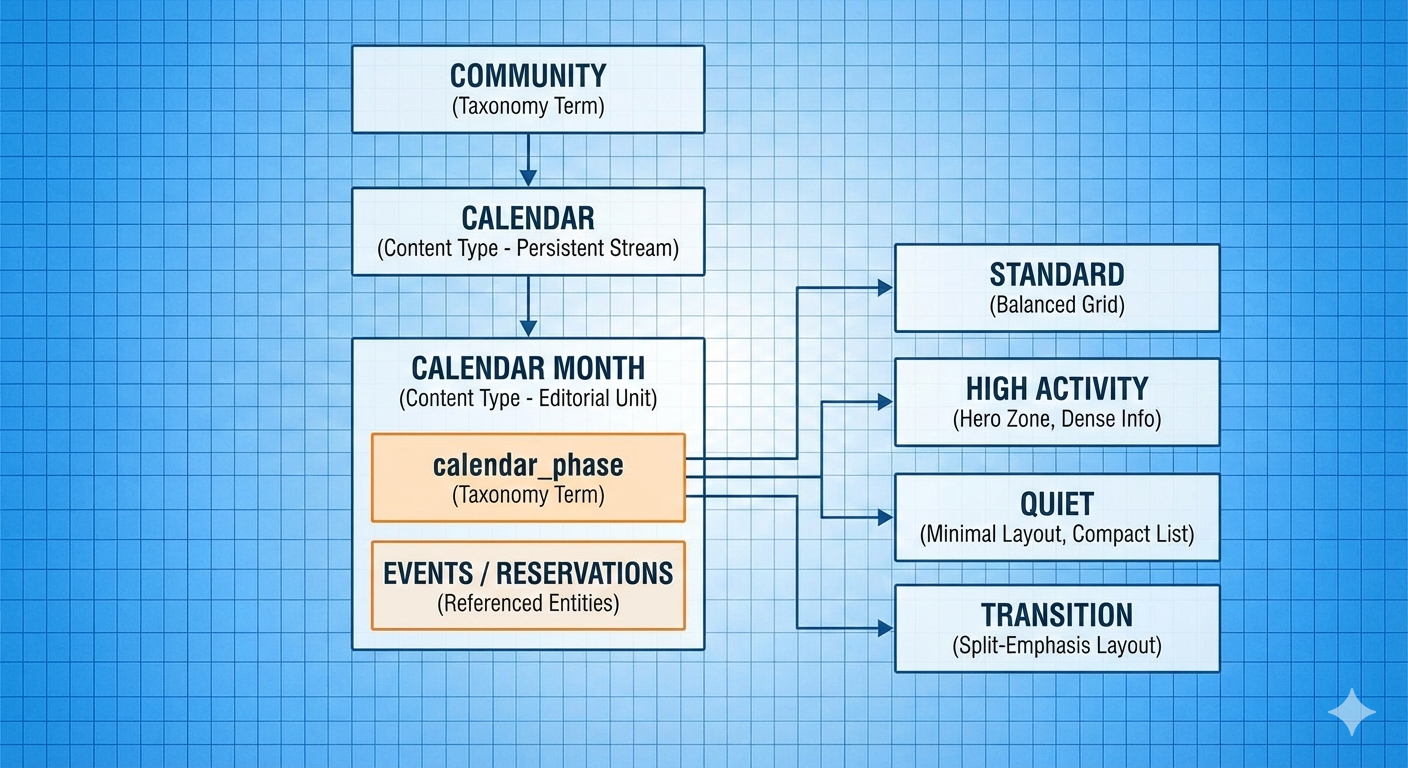
The data model looks like this:
Community (taxonomy term)
  └── Calendar (content type — the persistent stream)
        └── Calendar Month (content type — the editorial unit)
              └── Events / Reservations (referenced entities)
Each Calendar Month carries a calendar_phase taxonomy term. That term drives which display template gets applied. The archetype library ships with four defaults:
Standard — a balanced grid with event list and room availability. The workhorse.
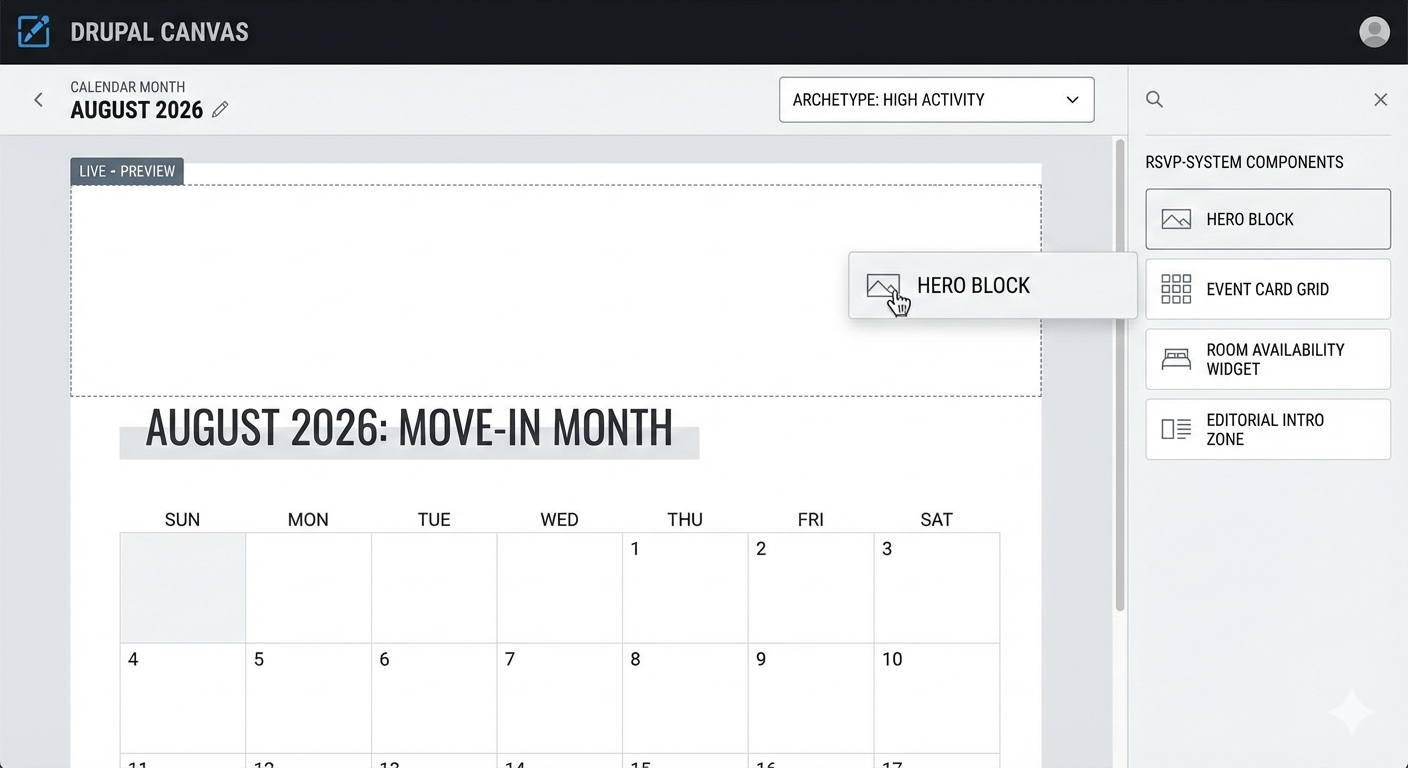
High Activity — a hero zone, featured events foregrounded, dense information architecture for weeks when a lot is happening and your community needs to find things fast.
Quiet — minimal layout, editorial notes, a compact event list. For slow weeks when a simple list is exactly right.
Transition — a split-emphasis layout for months that straddle two seasons or semesters. Space for what's closing and what's opening.
Taxonomy All the Way Down
The calendar_phase vocabulary connects to something bigger in RSVP-System's architecture.
The entire system is built around a two-level taxonomy: Community Type (college, municipality, nonprofit, coworking space) and Community (the specific organization). Views are filtered by URL context, so the same content type serves every community without custom routing.
The calendar phase system layers on top of this cleanly. A recipe for higher_education community types can pre-populate August → high_activity as a default, because that's true for almost every college. A recipe for municipal community types might pre-populate March → high_activity for town meeting season in Vermont.
These are sensible defaults, not constraints. Any administrator can override the phase on any month. The taxonomy gives you a lever; it doesn't lock you in.
Canvas Templates as Archetypes
The display layer for this system is being built around Drupal Canvas — the new visual page builder that shipped as part of Drupal CMS in late 2025. Canvas works by surfacing Single Directory Components (SDCs) to site builders and content editors through a visual interface.
The archetype templates are Canvas templates populated from RSVP-System's SDC library: hero blocks, event card grids, room availability widgets, file cabinet links, editorial intro zones. The calendar_phase term selects which template applies to a given month. A site builder can further customize any individual month beyond its archetype baseline — Canvas gives them the tools to do that without writing code.
This is actually the reason Calendar Month is a node and not a View. A View can't have a Canvas template. A View can't have a hero image, an editorial intro, or a featured events list that a content editor curated. A View just outputs whatever matches the date filter. We needed something richer.
The Practical Path
I'm building this against a real client right now: a small Vermont town government site migrating from Drupal 7 to Drupal 11. Canvas is still maturing (v1.1.0 as of this writing), so the initial implementation uses Layout Builder with per-node overrides. The components are all written as SDCs, which means when Canvas is ready for production use, the migration is a configuration change, not a rebuild.
That's the beauty of the SDC-first approach. The components don't care whether Layout Builder or Canvas is rendering them. You build the vocabulary once; the display layer catches up.
Why This Matters for RSVP-System
The pitch for RSVP-System has always been that it treats the community calendar as infrastructure, not an afterthought. Most organizations cobble together their calendaring from Google Calendar embeds, a WordPress events plugin, and a prayer. They get a grid. They don't get a system.
The Calendar Month archetype model is the concrete expression of what "treating it as infrastructure" means in practice. It gives communities the tools to say: here is what our year looks like, here is what this month means, here is how we want our community to experience it.
That's not a feature you find in a SaaS scheduling tool. It's only possible because we're building on Drupal's structured data model, taxonomy system, and component architecture — and because we're willing to think about the editorial problem, not just the data problem.
RSVP-System is an open-source Drupal platform for community reservation and event management, developed by Gluebox LLC. The project is publicly tracked on GitLab. If you're building something similar or want to collaborate, reach out.